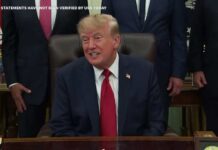

dailychive.com — Media fixation on President Trump’s “mortality” turned farcical when a White House aide reportedly blasted a CNN journalist amid routine Walter Reed coverage, spotlighting a familiar playbook of speculation over facts.
Story Snapshot
- The White House described President Trump’s Walter Reed visit as a routine annual exam and assessments [2][4].
- President Trump later confirmed he received an MRI, fueling media claims of incomplete disclosure [1].
- Coverage reflects a recurring pattern: broad official language invites expansive media speculation about health [4].
- Conservatives see agenda-driven narratives eclipsing facts while the administration carries on routine governance.
White House Framing: Routine Annual Exam and Assessments
White House officials characterized President Trump’s trip to Walter Reed National Military Medical Center as a routine yearly checkup, consistent with prior statements about annual dental and medical assessments [2][4]. The description tracked standard presidential practice, which often emphasizes continuity of care while limiting granular medical detail for privacy and security. The framing sought to reassure the public that the visit fit normal patterns for a sitting president, without signaling any acute or emergent health concern based on official language available at the time [4].
Reporters pressed for specifics beyond the term “routine,” asking whether any advanced testing occurred, and whether the cadence of visits suggested something more than standard preventive care. The White House language prioritized general descriptors over disclosure of test-by-test details, a long-standing approach in presidential medicine that balances transparency pressures with personal privacy. The emphasis on “routine” predictably triggered a fresh round of scrutiny from networks that tend to treat any ambiguity as a vacuum to be filled by conjecture [4].
Media Counter-Narrative: MRI Confirmation and Transparency Questions
President Trump later said, “I did. I got an MRI,” confirming at least one specific diagnostic procedure conducted during the Walter Reed visit [1]. That admission allowed critics to argue that earlier official phrasing had been incomplete, since “routine annual” language did not list out advanced imaging. The ensuing commentary revolved less around the medical significance of an MRI and more around whether communications discipline should have disclosed such details earlier, even if the results did not indicate a serious or new medical problem [1].
Coverage also referenced the president’s age to frame the visit as politically consequential, rendering each medical detail part of a broader 2026 election and governance storyline [2]. Analysts and commentators leaned on a transparency lens, suggesting that advanced imaging implied more than a checkup. However, none of the available reports established a diagnosis or acute concern. The substantive record remained limited to the routine framing by officials and the president’s confirmation of an MRI, absent disclosed findings or physician statements that signaled urgent risk [1][2].
Pattern Recognition: Routine Language Meets Speculation Cycles
Historical context shows a recurrent cycle in presidential health reporting: officials describe examinations in broad routine terms, while adversarial media push for granular disclosure, especially when an older officeholder undergoes repeat evaluations [4]. That tension often creates a media loop where ambiguity fuels commentary, even when available facts do not confirm a health crisis. In this episode, the loop intensified when the president acknowledged an MRI, which critics framed as proof that the routine label was insufficiently specific [1][4].
For conservative readers, this cycle feels familiar: sweeping narratives overshadow concrete facts, risk is amplified without documented findings, and privacy norms are treated as evasion rather than standard practice. The result is a climate where routine governance is recast as intrigue, and where a standard medical setting—Walter Reed—becomes a backdrop for political theater. The friction escalated when tempers reportedly flared toward a CNN journalist, channeling frustration over sensational framings that outpace confirmed medical information [4].
What We Know, What We Do Not, and Why It Matters
Confirmed facts establish that the White House labeled the Walter Reed trip as routine annual assessments, and the president later specified receiving an MRI [1][2][4]. Public sources in the research do not provide test results, diagnoses, or physician-level statements detailing concerns. Without results, risk narratives remain speculative. The central dispute is therefore not medical but informational: how much specificity the public should expect in real time when a president undergoes preventive or diagnostic care that may include advanced imaging [1][4].
Imagine that. Trump goes to Walter Reed Hospital today. Maybe the third time this year
— mary paich (@PaichMary) May 26, 2026
Limited disclosure is consistent with security and privacy considerations that surround any commander in chief. Demands for instant, exhaustive transparency can serve political incentives more than patient care. Until physician findings are released, the sound approach is to evaluate claims against the record: routine framing from officials, an MRI acknowledged by the president, and no verified diagnosis in public view. That standard protects truth over theater and helps citizens separate medical fact from media speculation [1][2][4].
Sources:
[1] YouTube – Trump Reveals He Got an MRI at Walter Reed
[2] Web – Trump doctor visit renews health scrutiny as 80th birthday nears
[4] YouTube – Trump at Walter Reed for medical checkup
© dailychive.com 2026. All rights reserved.