
A senior U.S. Marine general just landed in socialist-run Venezuela with warships and airlift at his back, and almost no one in Washington is asking hard questions.
Story Snapshot
- U.S. Marine Corps Maj. Gen. Kevin J. Jarrard is now in Caracas leading American military quake relief operations.
- The interim Venezuelan government formally asked the United States for help after deadly twin earthquakes.
- Powerful U.S. forces, including Navy ships and heavy airlift, are moving into the region under a humanitarian banner.
- Key details like exit timelines, on-the-ground oversight, and Congress’s role remain vague or missing.
Trump’s Team Sends a Senior General and Serious Hardware
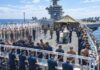
U.S. Marine Corps Major General Kevin J. Jarrard arrived in Caracas on June 25 to oversee Department of War support for earthquake relief in Venezuela, according to U.S. Southern Command statements.[5] Southern Command says he is the senior American commander on the ground and is directing U.S. military logistics to move people, gear, and aid into hard-hit areas.[5] This is not a small footprint. It is a flag officer on foreign soil, backed by serious capability.
Southern Command confirms that assigned U.S. units will use fixed-wing and rotor-wing aircraft to move search and rescue teams, assess damage, and deliver life-saving supplies.[5] Another official release adds that the command is “surging” forces already in the region to support the State Department’s relief mission after the June 24 quakes.[6] That surge includes Navy ships, heavy airlift aircraft, and reconnaissance platforms, all folding into the humanitarian push that the Trump administration is driving in America’s own hemisphere.[6]
Quake Disaster Opens the Door for U.S. Relief — and Renewed Scrutiny
Venezuela was struck by twin earthquakes on June 24, leaving at least 235 people dead, according to early international reporting.[5] Southern Command says the interim Venezuelan authorities formally requested American assistance after the disaster, and that the United States is supporting a State Department–led relief mission.[5][6] For many conservatives, this aligns with a simple principle. When people are buried under rubble and their government asks, America can and should send help.
At the same time, this mission lands on top of a long, messy history of U.S. military action in Latin America. Analysts note that, for more than a century, Washington has often used military, economic, and covert tools in the region to protect U.S. interests, sometimes at the cost of local stability and trust.[12] That history means every new deployment is watched closely by foreign media and global rivals, some of whom will claim that even genuine relief is just “cover” for power politics.
Ships, Airlift, and a Missing Exit Plan
Southern Command social media and releases show just how large this relief package could become. Command leadership has ordered significant forces forward, including the amphibious transport ship USS Fort Lauderdale and the littoral combat ship USS Billings, along with C-17 Globemaster and C-130 Hercules transport aircraft.[6] These assets are designed to move Marines, helicopters, engineering teams, and tons of cargo fast. They can turn a damaged port or airfield into a hub for rapid aid delivery.
These same platforms are also built for power projection, which is exactly why some foreign critics will spin the mission as a military occupation rather than help. For now, Southern Command statements focus on life-saving tasks, but they do not spell out how long U.S. forces will remain, what clear benchmarks must be met, or when control passes fully back to Venezuelan authorities.[5][6] That missing timeline raises fair questions for Americans who support strong borders and limited, clearly defined overseas missions paid for with their tax dollars.
Congress Quiet, Media Divided, and Contractors Watching
Public reporting so far highlights the arrival of the general and the tragic death toll but gives little detail about how aid is being tracked, which Venezuelan ministries are in charge, or how independent groups will verify that help reaches real victims instead of political favorites.[5] Past studies of Venezuela’s humanitarian crisis under Nicolás Maduro showed deep corruption and mismanagement, and emphasized the need for outside assistance that is transparent and accountable.[8] Without hard data on tonnage delivered, rescues completed, and people helped, critics across the spectrum will be ready to claim either failure or hidden motives.
U.S. Marine Corps Maj. Gen. Kevin J. Jarrard arrived in Caracas in the evening of June 25th, and is the senior SOUTHCOM official on the ground in Caracas currently.
U.S. Southern Command (SOUTHCOM) to support
ongoing earthquake relief efforts in Venezuela.SOUTHCOM Commander… pic.twitter.com/th1D15Y0uh
— Kagan.Dunlap (@Kagan_M_Dunlap) June 26, 2026
There is also almost no open talk yet about congressional oversight or the dollars involved. History shows that large humanitarian deployments often benefit major defense contractors that build transport aircraft and Navy ships used in these missions.[10] That does not mean the relief is fake, but it does mean Americans deserve candor about who gets paid, what the rules are, and how the mission will end. For a conservative audience that wants America strong but government limited, those answers matter as much as the headlines.
Sources:
[5] Web – RELEASE: SOUTHCOM Leadership Arrives in Venezuela to …
[6] Web – Senior US military official lands in Venezuela to oversee quake …
[8] X – Venezuela earthquake relief: U.S. Marine Corps Maj. Gen. Kevin J …
[10] Web – Made by Maduro: The Humanitarian Crisis in Venezuela and US …
[12] Web – The United States stands with the people of Venezuela following …
© dailychive.com 2026. All rights reserved.