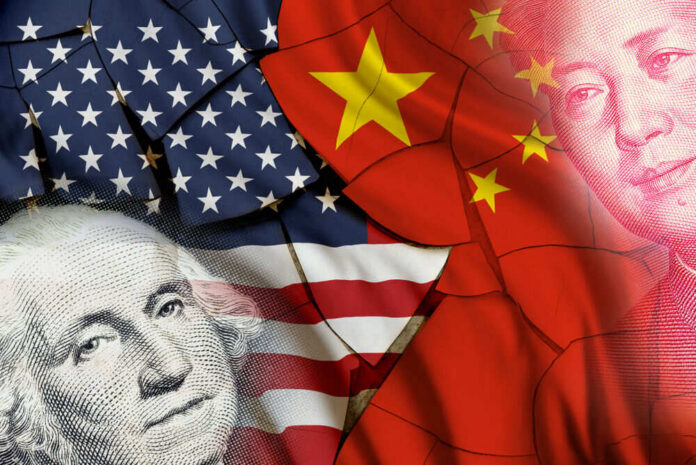
(DailyChive.com) – Americans continue to name China as the nation’s top foe for the fourth straight year, exposing deep bipartisan frustration with a federal government that many see as too weak to counter Beijing’s predatory advances.
Story Highlights
- 41% of Americans identify China as the greatest U.S. enemy, down slightly from 50% in 2024 but still holding the top spot.
- Republicans (67%) far outpace Democrats (18%) in viewing China as the primary threat, highlighting partisan divides.
- China’s Marxist-Leninist regime pursues global authoritarianism, distorting trade with a $295.4 billion U.S. deficit.
- Over 265,000 Chinese students in U.S. universities dwarf 800 Americans in China, raising espionage concerns.
Persistent Public Alarm Over China’s Threat
A Gallup poll reveals 41% of Americans name China as the greatest U.S. enemy in 2026, marking four consecutive years at the top. This perception stems from China’s strategic hostility, including economic predation and ideological export of authoritarianism. Republicans express heightened worry at 67%, compared to 18% of Democrats, reflecting conservative vigilance against threats to American sovereignty. Even as concern dips 9 points from 2024, China dominates threat rankings amid frustrations with elite-driven policies that fail ordinary citizens.
Systemic Differences Fuel Adversarial Stance
China operates as a Marxist-Leninist one-party dictatorship, treating political pluralism as an existential threat, unlike traditional competitors. Freedom House scores it 9/100 for repression of rights. The U.S. government designates China a foreign adversary alongside Russia and Iran under federal regulations. This framing justifies curbs on investments and tech exports, aligning with America First priorities to protect liberty and limit government entanglement in unfair global dealings.
Analysts reject “competitor” labels, arguing adversaries seek systemic destruction. Beijing aims to impose costs on free nations, elevating the clash to a battle over democratic governance models that resonate with founding principles of individual freedom.
Economic Imbalances Expose Government Failures
The U.S. faces a $295.4 billion goods trade deficit with China in 2024, fueled by subsidies and market distortions labeled predatory statecraft. Chinese intervention in sectors like electric vehicles undermines fair competition, hurting American workers. With Republicans controlling Congress under President Trump’s second term, pressures mount for tariffs and decoupling to revive manufacturing and shield families from inflation tied to past fiscal mismanagement.
Asymmetric student flows—265,919 Chinese in U.S. schools versus 800 Americans in China—signal one-way intelligence gains, amplifying deep state concerns where elites prioritize globalism over national security.
Bipartisan Frustrations Amid Shifting Perceptions
While 56% of Americans call China a competitor and 33% an enemy, majorities see Taiwan tensions as vital to U.S. interests, sustaining Indo-Pacific worries. Partisan gaps persist—58% of Republicans versus 28% of Democrats rank China top threat—yet growing consensus emerges that Washington elites favor reelection over confronting Beijing’s authoritarian push. This unites left and right against a government failing the American Dream of hard work and self-reliance.
Former CIA voices warn China bankrolls rivals, forming a threat network that demands unified resolve beyond party lines to restore principled leadership.
Sources:
Americans Name China as Nation’s Top Foe, Russia Second
China Not a Competitor, but America’s Top Adversary – Miles Yu | Hudson Institute
Views of China as a Competitor and Threat to the U.S. | Pew Research Center
Copyright 2026, DailyChive.com