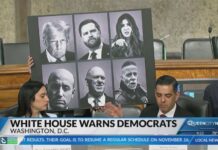

A sealed federal probe into Representative Ilhan Omar’s immigration history reportedly led agents to seize her passport and devices, raising high-stakes questions about truth, fairness, and power in Washington.
Story Highlights
- Federal investigators are reportedly examining possible false statements and immigration fraud tied to Omar’s entry and naturalization.
- Agents allegedly searched her residence and seized electronic devices, documents, and her passport.
- Omar denies wrongdoing and calls the investigation political targeting by law enforcement.
- No charges have been filed; key warrant materials remain sealed, limiting public evidence.
What Investigators Are Reportedly Probing
Reuters reported that a sealed warrant named conspiracy, false statements on immigration paperwork, and immigration fraud as possible crimes under review. Sources said investigators are looking at whether false information was given during her family’s refugee entry in the 1990s or during naturalization. This is a serious path. Denaturalization and removal require clear proof that citizenship was obtained through willful misrepresentation. Yet such cases are uncommon and often complex to prove in court.
Reporting also links the probe to irregularities that critics cite from past records. A state board found Omar filed joint federal tax returns with Ahmed Hirsi in 2014 and 2015 before dissolving her marriage to Ahmed Nur Said Elmi, fueling allegations about her prior marriages. Those records do not prove immigration fraud by themselves. They do, however, explain why investigators might recheck older files if they see mismatched names, dates, or relationships across forms.
The Reported Search And What It Does Not Prove
Coverage says Homeland Security investigators searched Omar’s Washington residence and took documents, devices, and her passport. A search shows a judge agreed there was probable cause to look for evidence. It is not proof of a crime. The supporting affidavit, which would show the government’s evidence and reasoning, remains sealed in public reporting. Without it, the public cannot judge what new facts, if any, changed the government’s view since earlier reviews.
Past reporting said investigators in 2019 saw insufficient evidence to move forward, creating a credibility test for any new claims now. If officials reopened the matter, they likely believe new records, witness statements, or digital traces exist. Until that becomes public, the gap between a high-profile search and an actual charge will invite political spin from both sides. That vacuum often hurts public trust in institutions.
Omar’s Response And The Disputed Allegations
Omar and her attorneys deny immigration fraud and say there is no legitimate basis for claims that threaten her citizenship. She called the search political targeting and the weaponization of federal law enforcement. She also rejects the claim she married a brother as a sham, calling it a long-running falsehood. Supportive coverage notes that these marriage allegations began on a blog and have not been proven in public records. No court has found her guilty of immigration fraud.
Some reporting points to a proponent-authored legal brief that alleges a 2009 marriage to Ahmed Nur Said Elmi to gain benefits. That document reflects advocacy, not a court finding. The Washington Examiner’s review says public proof of a sibling relationship has not been established. Claims that she shared classified information with Somali officials also lack named recipients, dates, or verified records in the available material. These gaps matter because specific, documented proof is what courts require.
Why This Case Resonates Beyond One Lawmaker
This probe lands in a tense era where many Americans believe powerful elites bend rules while average families face rising costs and shrinking trust. Supporters of strict enforcement see a test of equal treatment under the law. Civil libertarians see another test: whether agencies can raid a critic without making a public, evidence-based case. Both concerns are real. A sealed process can feel like shadow justice, especially when lives and citizenship are on the line.
Big picture, the government has pushed more denaturalization cases in recent years, but success depends on clear proof of willful lies, not confusion or childhood paperwork errors. If the Justice Department files charges or a denaturalization suit, the evidence will finally face a judge. If not, this episode will read as another spectacle that deepens the sense that Washington uses process as punishment. Either way, transparency and due process will decide public trust here.
Sources:
youtube.com, yahoo.com, nytimes.com, arabnews.pk, bringmethenews.com, washingtonexaminer.com, reuters.com, ilhanomardna.com, fox9.com
© dailychive.com 2026. All rights reserved.