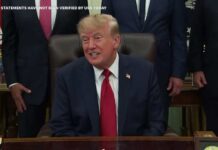

As President Trump’s Pentagon spends big on war and weapons, his sons’ growing stake in defense tech is turning that public money into private family opportunity on a scale the system was never built to police.
Story Snapshot
- Trump’s sons are tied to more than a dozen defense and military tech firms winning billions in federal contracts.
- Key investments include drone makers and a venture fund whose portfolio has surged after Trump Jr. joined as partner.
- Democratic senators say the Defense Department lacks tools to stop conflicts of interest involving the president’s family.
- The White House and companies involved insist there is “no conflict” and that deals were won on merit.
Trump sons move into war-linked business
Since Donald Trump’s second term began, Donald Trump Jr. and Eric Trump have shifted from focusing mainly on real estate and branding into the booming defense technology world. A Washington Post-backed analysis found that investment funds tied to the brothers have stakes in more than a dozen companies chasing business from the Pentagon and other federal agencies. Those firms have booked at least $3.2 billion in government awards, plus another $3.1 billion in future options, much of it driven by rising drone and robotics spending during Trump’s renewed “rearm America” push.
Several of the most visible deals involve military drones, a technology Washington is racing to expand after banning most Chinese-made systems. Donald Trump Jr. holds about $4 million in shares and a board seat at Unusual Machines, a drone parts company that has landed more than $15 million in defense-linked orders, including from the United States Army’s 101st Airborne Division. Eric Trump has invested in the Israeli-founded drone maker Xtend and backed Powerus, a Florida startup marketing interceptor drones, as they seek a share of a Pentagon drone program budgeted at roughly $1.1 billion.
How the money flows from policy to profit
Critics focus on the timing: Trump policy choices create demand, and companies tied to his sons then win contracts in that same lane. Donald Trump Jr. joined the venture firm 1789 Capital shortly after his father’s reelection; within months, its portfolio companies secured more than $70 million in Pentagon awards, including a large artificial intelligence chip project and a $620 million loan to drone-parts maker Vulcan Elements. A ProPublica probe reported that the White House asked the Defense Department to arrange that loan, sparking internal concern because it bypassed normal competitive steps.
Powerus shows another pattern that troubles watchdogs. The firm announced a reverse merger with Aureus Greenway Holdings, a golf-course company backed by the Trump sons, which would take Powerus public and give them a direct stake. Weeks later, as war with Iran entered its third month, the United States Air Force placed a first order for Powerus interceptor drones and the company began competing for a chunk of the new Drone Dominance Program. To many Americans who already feel elites rig the game, this looks like war policy turning into a carefully positioned revenue stream for the president’s family.
Defense, denials, and gaps in the rules
The Defense Department and the companies involved deny that any special favor is at work. Spokespeople for multiple firms have said contracts were won “on merit” and that Eric Trump is a passive investor with no role in daily operations or bidding. The White House press office, through spokesperson Anna Kelly, has stated flatly that “there are no conflicts of interest,” stressing that Trump’s adult sons hold no official government jobs and are therefore not subject to federal conflict-of-interest laws that apply to employees.
That legal gap is central to the broader worry. Existing ethics rules were built for civil servants, not for a president’s relatives running private funds with billions under management. Senator Elizabeth Warren pushed legislation years ago that would have forced presidents to place business holdings in blind trusts, but Congress never passed it. With 1789 Capital reportedly managing around $3.5 billion and not required to fully disclose its holdings, watchdog groups say neither the public nor Congress can see the whole map of where Trump family money overlaps with Pentagon decisions.
Growing bipartisan unease about a “Pentagon ATM”
Democratic Senators Warren, Richard Blumenthal, and Andy Kim formally warned the Defense Department in January 2026 that firms linked to Trump Jr. had already secured at least $70 million in contracts and loans, and they questioned whether any safeguards were in place. Their follow-up letter after an Armed Services Committee hearing argued that the department appears to lack “effective processes” to prevent conflicts or corruption involving the president’s family and Pentagon awards. Representative Jason Crow, a former Army Ranger, went further, saying more war in the Middle East “means more money in the pockets of the Trump family,” based on new reporting tying the sons to $3.7 billion in defense deals.
Trump’s sons invest heavily in defense tech as their father’s administration pours money in, a Washington Post analysis finds
Most investments by funds linked to Donald Trump Jr. and Eric Trump have taken place since their father’s 2024 election. https://t.co/qlkc0Bi8jc
— Jonathan Htet (@jonathan_htet) July 13, 2026
At the same time, the pattern fits a longer history that many conservatives and liberals alike find troubling. Government ethics groups documented more than 3,400 conflicts of interest tied to Trump businesses in his first term, from foreign officials staying at his hotels to events held at his properties on the public dime. Now, instead of hotel bills, the focus is on high-tech weapons, rare-earth minerals, artificial intelligence chips, and battlefield robots. For citizens who already feel both parties protect insiders first, the idea that war decisions might enrich a president’s family through opaque investment vehicles deepens the sense that the system serves the powerful before the people.
Sources:
responsiblestatecraft.org, warren.senate.gov, newser.com, youtube.com, pbs.org, chosun.com, facebook.com, thedailybeast.com, apnews.com, ms.now, thehill.com, forbes.com, edition.cnn.com, defenseone.com, newsbreak.com
© dailychive.com 2026. All rights reserved.