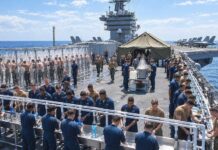

Families say sailors on the USS Abraham Lincoln tried to jump overboard after months at sea, forcing a hard look at mental health in the fleet.
Story Snapshot
- Peer-reviewed studies show high depression risk during shipboard deployment, across all phases.
- Navy-linked research documents psychiatric medical evacuations from a carrier battle group.
- Symptoms often rise mid- to late-mission, while strong family support helps buffer stress.
- The Navy has expanded onboard counseling and 24-hour access to care during deployments.
What sparked the alarm aboard a front-line carrier
The Guardian reported that sailors on the aircraft carrier USS Abraham Lincoln, deployed for months, attempted to jump overboard, highlighting severe strain at sea. The report described families’ concerns about exhaustion and morale. The account does not provide ship medical logs or full incident data. Still, it aligns with a larger research record that shows deployment stress often peaks as time away grows. The story has intensified calls for more transparent data and stronger safeguards across the fleet.
Shipboard research gives the claim a factual backdrop. A peer-reviewed study on deployed sailors found that more than half screened positive for risk of depression at every time point in the deployment cycle, suggesting shipboard duty includes unique mental stressors. Another study mapped shipboard sailors’ health and found behavioral health burdens similar to those seen in ground combat, underscoring how intense life at sea can be, even outside direct combat. These findings support closer tracking of risk during long cruises.
What the Navy and its studies say about rising symptoms
Naval Medicine research found minor psychiatric symptoms tend to increase by the middle and near the end of missions, and that stronger family support can blunt or even halt that rise. This pattern points to time away, disrupted sleep, and distance from support as steady pressures that build. The United States Naval Institute’s Proceedings tied record-setting deployments and maintenance delays to force and family health strain, which matches what crews and spouses report during extended sea time.
Clinical severity also appears in the record. A Navy force-health protection report documented psychiatric medical evacuations during a six-month aircraft carrier battle group deployment to the Persian Gulf, proving that shipboard stress can lead to serious clinical events requiring removal from the ship. While one deployment’s events do not prove another’s, the presence of documented medevacs shows that dangerous cases do occur at sea and must be planned for with robust, immediate care options.
What the fleet is doing now, and where gaps remain
The Navy has moved to place licensed counselors and trained educators on surface ships during early deployment weeks under the Departure and Separation Program, an acknowledgment that stress spikes early and can be managed with onboard help. Carrier teams also promote “warrior toughness,” urging sailors to sleep when they can and to reach medical staff, chaplains, and resiliency counselors. That message aims to normalize care-seeking and build habits that keep stress from spiraling.
The aircraft carrier USS Abraham Lincoln also promotes 24-hour access to care, including mental health support, so sailors can get help when stress crests at odd hours at sea. These steps address access barriers many sailors cite. But existing programs do not fully answer core questions raised by families: how many severe cases develop during very long cruises, how quickly help arrives, and whether sleep, manpower, and maintenance shortfalls make support efforts less effective over time. Public, de-identified data could help settle those points.
Why this matters beyond one ship
Prolonged strain at sea hits readiness, safety, and trust. When crews lose sleep and morale, errors rise, tempers flare, and small problems compound. Both conservatives and liberals see a federal system that struggles to face hard truths. This topic fits that concern. Clear numbers on counseling visits, crisis responses, and medical evacuations during long deployments would show whether policy fixes match the real load on the deckplates. Without that transparency, doubt grows and crews shoulder the cost.
🚨🇺🇸🇮🇷 Sailors on the USS Abraham Lincoln have tried to JUMP overboard after 250 days at sea
-Navy Times and Stars and Stripes report multiple attempts by crew members to go overboard as conditions and mental strain aboard the carrier reach a breaking point
-The roughly 5,000… pic.twitter.com/d2xrckmR4I
— Royalty 👑👑 (@bash_shar) August 12, 2026
Leaders can close the gap with simple steps. First, publish de-identified counts of behavioral health encounters, emergency responses, and evacuations per deployment phase. Second, ensure stable sleep and manning plans, then report compliance. Third, widen mid- and late-mission family contact windows, since support at home reduces symptoms. These are not partisan goals. They are basic stewardship of people who carry national risk at sea. Data, not spin, will keep faith with sailors and families.
Sources:
19fortyfive.com, usni.org, theguardian.com, academic.oup.com, apa.org, wavy.com, reddit.com, americanhomefront.wunc.org, pmc.ncbi.nlm.nih.gov
© dailychive.com 2026. All rights reserved.