
(DailyChive.com) – Trump’s latest Iran ultimatum puts a red line through civilian power and water systems—dragging America closer to the kind of open-ended war many voters thought was off the table in a second Trump term.
Story Snapshot
- The Iran war has reached roughly its 31st day, with Washington and Tehran trading threats tied to energy and water infrastructure.
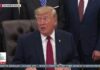
- President Trump threatened strikes on Iranian power plants tied to demands that Iran reopen the Strait of Hormuz, then paused action while claiming talks; Iran denied negotiations.
- U.S.-Israeli opening strikes—reported at roughly 900—killed Iran’s Supreme Leader Ali Khamenei and triggered wide retaliatory missile and drone attacks.
- The conflict’s most immediate U.S.-side pressure point remains energy: chokepoint risks at Hormuz and spillover threats to regional shipping and facilities.
Infrastructure Warfare Raises High-Stakes Questions for U.S. Strategy
President Donald Trump’s pressure campaign has centered on forcing Iran to reopen the Strait of Hormuz, a global energy chokepoint that directly affects fuel prices and supply stability. Reporting summarized in the provided research says Trump threatened strikes on Iranian power plants if Tehran did not comply, framing the threat as leverage during a fast-moving conflict. The same material also says the administration later delayed action for several days while asserting negotiations were underway, a claim Tehran disputed.
For conservatives watching groceries, utility bills, and gas prices, the immediate worry is predictable: when war and energy collide, working families pay first. The research also flags Iranian counter-threats involving regional energy and water infrastructure, raising the possibility of attacks on assets that civilians rely on—power generation, desalination, and shipping. The sources referenced in the research do not confirm that large-scale water or energy attacks have already been carried out; they describe threats and escalation risk.
How the War Started—and Why It Escalated So Fast
The conflict, as outlined in the research, ignited with a major U.S.-Israeli strike package on Feb. 28 under “Operation Epic Fury,” described as roughly 900 strikes. The same timeline says the opening phase killed Iran’s Supreme Leader Ali Khamenei and caused significant civilian deaths, including a reported incident in which about 170 people were killed at a girls’ school. Iran’s response followed quickly with missiles and drones aimed at U.S. and Israeli targets, described as “True Promise IV.”
That level of escalation matters because it narrows political exit ramps. The research notes U.S. force posture in the region—including major carrier deployments and bomber movements—signaling a large, sustained operation rather than a short punitive strike. It also describes multiple fronts and aligned groups, including Hezbollah, the Houthis, and Iraqi militias, increasing the risk that U.S. forces and partners face repeated attacks while Washington’s objectives expand beyond deterrence into coercion and potential regime outcomes.
MAGA’s Internal Split: Israel, War Aims, and “No More Regime Change”
The provided research emphasizes the war’s “regime decapitation” aspect and highlights that the operation was joint with Israel, placing the U.S.-Israel alliance at the center of decision-making. That reality is colliding with a growing division among Trump-aligned voters: many remain firmly pro-Israel while also rejecting another long, expensive Middle East war. The research also references Iranian protests and U.S. statements supporting protesters earlier in 2026, an angle that can blur into regime-change expectations.
On the facts available, the administration’s public posture has mixed goals—protect shipping lanes, blunt nuclear and missile threats, and pressure Tehran’s leadership—while the conflict’s day-to-day mechanics look like an expanding campaign. That gap is what fuels distrust among voters who remember Iraq and Afghanistan: limited objectives can become open-ended commitments. The research does not provide a clear, published congressional authorization framework or a defined endpoint, leaving key constitutional and oversight questions unresolved.
Economic Shock Risk: Hormuz Chokepoint Meets Domestic Energy Pain
The research repeatedly returns to the Strait of Hormuz and wider maritime threats, including mentions of pressure around Bab al-Mandab as well. When adversaries threaten chokepoints, the consequence is not theoretical: markets price in disruption, insurers raise premiums, and fuel costs can jump quickly. The research also notes travelers stranded and oil-price pressure as the conflict drags on. For U.S. households already sensitive to inflation, prolonged instability can hit hard even without a formal draft or full mobilization.
At the same time, the escalation toward targeting civilian-critical systems—electric grids, energy facilities, and water infrastructure—creates moral and strategic hazards. Conservative voters typically support decisive action against terror networks and hostile regimes, but they also recoil at policies that look like collective punishment or mission creep. The research includes a cautionary note attributed to Iranian opposition figure Reza Pahlavi urging that civilian infrastructure be spared for rebuilding—an indicator that even anti-regime voices fear long-term humanitarian and political blowback.
Sources:
https://en.wikipedia.org/wiki/2026_Iran_war
https://www.britannica.com/event/2026-Iran-War
https://eismena.com/en/article/war-us-israel-vs-iran-timeline-2026-2026-03-04
Copyright 2026, DailyChive.com