
(DailyChive.com) – When 5,000 uniformed troops occupy America’s second-largest city in peacetime, then nearly all vanish overnight with barely a word, you know you’re witnessing a showdown that will echo for years in the nation’s memory and its law books.
Story Snapshot
- The Trump administration rapidly withdrew over 4,700 National Guard and Marine personnel from Los Angeles after weeks of anti-ICE protests and political backlash.
- California leaders fought the deployment in court, invoking state sovereignty and the Posse Comitatus Act, fueling a national debate on military force in civil unrest.
- The cost, financial, political, and social, exposed deep fractures between federal authority and states’ rights with direct impact on immigrant communities and public safety.
- Legal and political ripple effects from this standoff are already shaping how America responds to future protest movements and federal-state conflicts.
The Most Militarized Moment in Modern Los Angeles: June 2025
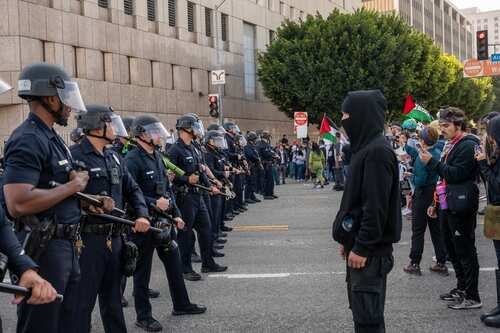
Few Angelenos will soon forget the sight: armored vehicles rumbling past taco stands, helicopters thundering above the 101, and lines of camouflage-clad troops posted outside government buildings. For nearly two months in summer 2025, Los Angeles experienced a deployment of National Guard and Marine personnel unseen since the 1992 riots. This time, though, the enemy wasn’t looters or arsonists, it was a swelling tide of anti-ICE protesters, furious over federal immigration raids that swept through immigrant neighborhoods with chilling efficiency. The Pentagon’s show of force, at President Trump’s direction, triggered an instant and visceral backlash from city hall to Sacramento. Legal challenges erupted as Governor Newsom and Mayor Karen Bass denounced the move as a violation of state rights and a dangerous precedent in the use of military for civilian unrest.
Within days of the June 7 deployment, the city’s power struggle became national news. While federal officials claimed the mission was to “protect federal property and personnel,” state leaders argued the cost, estimated at $134 million, came at the expense of wildfire readiness and public trust. For those on the ground, the message was clear: Los Angeles had become the nation’s proving ground in an escalating war over immigration and federal authority.
Legal Firestorm: The Posse Comitatus Act and State Sovereignty
The legal battle over the troop deployment exposed the fragility of America’s constitutional balance. California’s lawsuit, spearheaded by Governor Newsom, invoked the Posse Comitatus Act, a 19th-century law meant to keep the military out of domestic law enforcement. State lawyers argued that the administration’s move blurred the line between federal and local authority, risking both civil rights and public order. The courts initially sided with California, but federal appeals reversed those decisions, allowing the Pentagon to keep boots on the ground while legal wrangling continued. Even among legal scholars, the episode rekindled debate over just how far Washington can go to quell dissent inside state borders. For many residents, it was less about arcane statutes and more about the daily reality of living under occupation, even if “temporary.”
The deployment also forced city leaders to confront practical dilemmas. National Guard members, many of whom usually fight wildfires or respond to floods, were reassigned from their regular duties. Meanwhile, immigrant communities, already on edge from ICE sweeps, faced a new wave of anxiety, with some residents afraid to attend school or seek medical care.
Political Theater or Necessary Order? The Great Drawdown
By early July, the protests had largely dissipated. The city’s streets, once filled with chants and banners, fell quiet except for the hum of military convoys departing town. The Pentagon, citing “reduced unrest,” began a phased withdrawal: first the Marines, then wave after wave of National Guard troops, until only 250 remained to guard two federal buildings. The optics were unmistakable. Mayor Bass called the pullback a “win for Los Angeles,” promising to keep the pressure on until the last soldier left. Governor Newsom, undeterred, denounced the entire episode as “political theater” and a gross misuse of military power. On the other side, Trump administration officials insisted the deployment was always about safety, not politics, a claim met with skepticism by critics who saw echoes of past federal crackdowns from Portland to Lafayette Square.
The remaining troops, now focused on protecting ICE offices and a detention facility, became a symbol of the unresolved tension between federal and state priorities. For the National Guard members themselves, it was a mission fraught with uncertainty, caught between orders from Washington and the communities they were sworn to serve.
What Happens Next: Lessons, Legacies, and Open Questions
The rapid drawdown may have calmed Los Angeles for now, but the precedent is set. Legal experts warn that the ease with which thousands of troops were sent, and then withdrawn, will shape future administrations’ responses to civil unrest. State leaders, emboldened by their resistance, are already calling for reforms to limit federal intervention in local crises. Meanwhile, the immigrant communities at the heart of the original protests remain wary, their trust in government further eroded by months of tension and uncertainty.
The financial toll, $134 million and counting, has reignited debate over emergency priorities, especially as wildfire season looms. For many, the episode is less a resolved chapter than an open loop, a reminder that the next protest, crisis, or White House directive could once again tip the balance between security and civil liberty. In the end, the summer of 2025 may be remembered not just for the troops who came and went, but for the questions they left behind.
Copyright 2025, DailyChive.com