

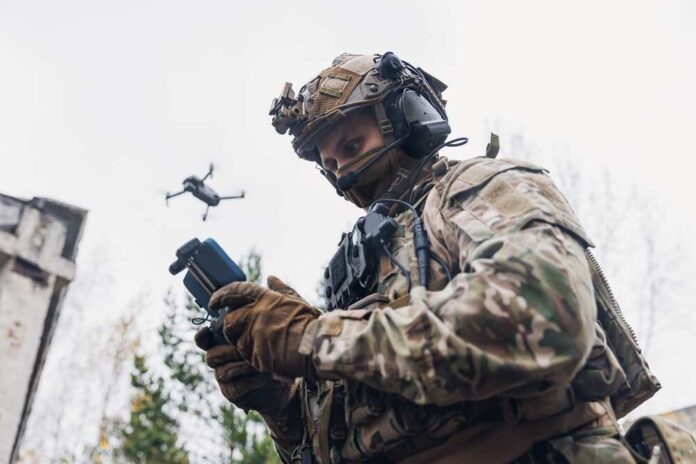
(DailyChive.com) – Pentagon launches new counter-drone task force with unprecedented funding flexibility to combat the “asymmetric warfare” threat that has military leaders comparing today’s drone crisis to the IED challenges of Iraq and Afghanistan.
Key Takeaways
- The Department of Defense is establishing a new Joint Interagency Task Force led by the Army to counter the growing threat of weaponized drones
- The task force seeks “colorless” funding of $858 million for FY2026 to bypass traditional budget cycles and rapidly deploy solutions
- Defense strategy combines electromagnetic systems (lasers, microwaves, jammers) and kinetic solutions (interceptors, rockets) in a layered approach
- The initiative is modeled after the Joint IED Defeat Organization from the Iraq/Afghanistan wars, reflecting the urgency of the current drone threat
Army Takes Lead in New Counter-Drone Initiative
The Department of Defense announced in July 2025 the formation of a new Joint Interagency Task Force specifically designed to combat the proliferation of unmanned aerial threats. Led by the U.S. Army under the direction of General James Mingus, this task force represents the Pentagon’s most aggressive response yet to what military leaders describe as a rapidly evolving asymmetric threat. The initiative will coordinate efforts across multiple military branches and government agencies to develop and deploy integrated counter-drone systems faster than traditional acquisition processes allow.
The new task force is deliberately modeled after the Joint Improvised Explosive Device Defeat Organization (JIEDDO), which was created during the height of the Iraq and Afghanistan conflicts to rapidly counter the IED threat that was claiming American lives. This historical parallel is no accident – Pentagon officials view today’s drone threat with the same urgency that IEDs presented two decades ago, requiring an equally swift and flexible response mechanism outside normal bureaucratic channels.
The Growing Drone Threat Landscape
Military leaders point to conflicts in Ukraine and the Middle East as evidence of how commercial and homemade drones have fundamentally changed modern warfare. What makes these threats particularly challenging is their low cost and high accessibility – adversaries can now deploy swarms of weaponized drones for a fraction of what it costs to defend against them. This cost imbalance creates what defense officials call a “negative cost exchange ratio” where American forces spend millions defending against threats that cost enemies mere thousands to deploy.
“We’re seeing adversaries leverage commercially available technology, 3D printing capabilities, and simple weaponization techniques to create threats that can overwhelm traditional defenses,” said Gen. Mingus during the announcement briefing. “The threat has evolved faster than our defensive capabilities, and this task force aims to close that gap quickly.” The proliferation of drone technology has democratized aerial attack capabilities that were once limited to nations with advanced air forces, creating new vulnerabilities for even the most sophisticated military forces.
Electromagnetic and Kinetic Solutions Form Defense Strategy
The Pentagon’s counter-drone strategy relies on what officials describe as a “system-of-systems” approach, combining both electromagnetic and kinetic solutions in layered defenses. On the electromagnetic front, the task force is accelerating development of directed energy weapons including high-powered lasers and microwave systems that can disable drone electronics without firing a shot. Radio frequency jammers that disrupt command and control signals represent another non-kinetic approach being prioritized.
“No single technology will solve this problem,” explained Col. Michael Parent of the Joint Counter-small Unmanned Aircraft Systems Office (JCO), which will work alongside the new task force. “We need layered defenses that can detect, track, identify and defeat these threats across the full spectrum of operations, from individual soldiers in the field to major installations and formations.” The JCO has been conducting demonstrations of various counter-drone technologies at Yuma Proving Ground to evaluate their effectiveness in contested electromagnetic environments.
For kinetic solutions, the task force is evaluating low-cost interceptors, guided rockets, and even “drone-killing drones” that can physically eliminate aerial threats. These systems become particularly important when facing autonomous drones that continue operating even when communications are jammed. The Pentagon refers to this balance between electromagnetic and physical countermeasures as the “kinetic pendulum” – recognizing that different threat scenarios require different defensive approaches.
Funding Flexibility Critical to Mission Success
Perhaps the most significant aspect of the new task force is its funding structure. The Army has requested $858 million for counter-UAS efforts in fiscal year 2026, with leaders pushing for what they call “colorless” funding that isn’t tied to traditional budget categories. This approach would allow the task force to rapidly shift resources between research, procurement, and deployment without the delays typically associated with Defense Department acquisitions.
“The authorities must align with funding flexibility,” Gen. Mingus emphasized. “Our adversaries don’t wait for our budget cycles to innovate, and neither can we.” This funding approach has raised some eyebrows in Congress, where oversight committees typically maintain strict control over how defense dollars are allocated. However, military leaders argue that the drone threat represents an emergency situation requiring extraordinary measures.
Testing Capabilities in Contested Environments
A critical component of the Pentagon’s counter-drone strategy involves rigorous testing of systems under realistic combat conditions. The JCO conducted a demonstration in April 2025 that specifically evaluated how counter-drone systems perform when electronic warfare tactics are employed against them. This testing revealed significant vulnerabilities in some systems when operating in electromagnetically contested environments – precisely the conditions American forces would face in conflicts with near-peer adversaries.
“Our adversaries know we rely heavily on the electromagnetic spectrum for our operations,” said a senior defense official familiar with the testing. “They will attempt to jam, spoof, or otherwise degrade our counter-drone systems. We need to ensure our defenses work even when communications are compromised.” The JCO has scheduled another demonstration for early 2026 specifically focused on electromagnetic resilience, testing sensors, jammers, and kinetic interceptors under degraded conditions.
Copyright 2025, DailyChive.com