

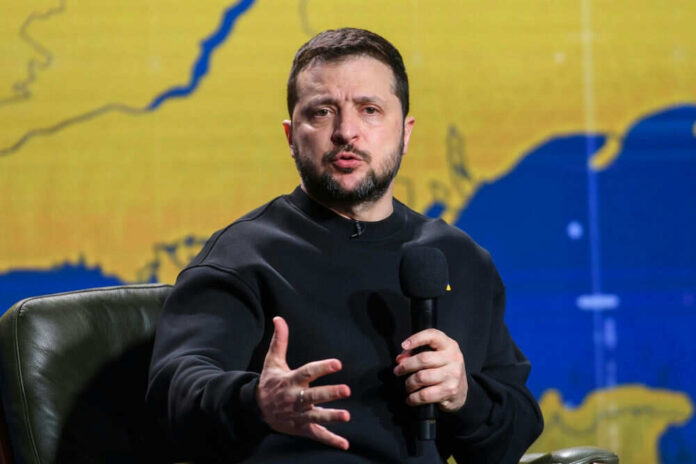
(DailyChive.com) – Four military-style drones breaching a no‑fly zone to track a wartime president’s jet shows exactly how exposed Western airspace has become in an era of cheap unmanned threats.
Story Highlights
- Four unidentified military-style drones reportedly flew toward President Zelensky’s aircraft as it approached Dublin Airport, breaching a restricted no-fly zone.
- Irish authorities launched a major security investigation, treating the event as a serious airspace intrusion with potential hybrid warfare implications.
- Experts warn the incident fits a broader pattern of grey-zone tactics used to intimidate, probe defenses, and test political will without open warfare.
- The breach has intensified debates in Ireland and across Europe over defense spending, counter-drone systems, and readiness against Russian-style hybrid operations.
Drones breach no-fly zone near Zelensky’s jet
Initial reports describe four military-style drones entering restricted airspace near Dublin Airport and flying in the direction of the aircraft carrying Ukrainian President Volodymyr Zelensky as it approached to land, triggering alerts among Irish authorities and air traffic security. The drones reportedly moved in a way that appeared to shadow or close on the presidential flight path, raising immediate questions about possible hostile intent, intimidation, or reconnaissance rather than a random hobbyist violation.
The incident unfolded around a tightly controlled visit by a wartime leader whose movements are usually shrouded in secrecy, underscoring how even carefully planned trips remain vulnerable when relatively inexpensive drones can penetrate no-fly zones near major airports. Authorities enforcing the restrictions around Dublin were forced to treat the approach as a credible threat scenario, highlighting the difficulty of guaranteeing airtight protection for high-profile targets in crowded, complex airspace.
Hybrid warfare concerns and Russian context
Since Russia’s full-scale invasion of Ukraine in 2022, Western intelligence services have repeatedly warned that Moscow and aligned actors lean on drones, cyber operations, and disinformation to wage hybrid campaigns that intimidate adversaries and probe defenses without triggering formal war. Analysts view the Dublin drone breach through this lens, noting Russia’s prior pattern of provocative but deniable actions across Europe, even as investigators emphasize that direct attribution in this case remains unproven and under active review.
Security experts describe such drone incidents as classic grey-zone tactics, where an adversary uses small, hard-to-attribute systems to test radar coverage, response times, and political resolve while gaining psychological leverage over both leaders and the public. In this scenario, simply forcing Irish and allied authorities to scramble, investigate, and publicly reassure citizens can be a strategic win for whoever launched the aircraft, even if no physical damage occurs and no one claims responsibility.
Ireland’s security gaps under the spotlight
Irish officials and Garda Síochána now face pressure to determine where the drones were launched, whether from populated land near Dublin or possibly from an offshore vessel, exposing longstanding gaps in coastal and urban drone monitoring. Investigators are examining radar traces, eyewitness accounts, and any electronic signatures or debris that might reveal whether the aircraft were modified commercial platforms or purpose-built for military or intelligence roles, a distinction that could reshape how authorities categorize the threat.
The government’s public messaging has tried to balance transparency with caution, acknowledging the seriousness of the breach while avoiding premature claims about who controlled the drones or what their ultimate objective was. Political voices in Ireland and across the European Union are seizing on the episode to argue that under-investment in air defense, intelligence capabilities, and counter-drone technology has left critical infrastructure, VIP movements, and even commercial traffic more exposed than citizens were led to believe.
Strategic implications for air travel and defense
In the short term, the Dublin incident is likely to tighten no-fly zones, harden protocols for VIP visits, and accelerate deployment of counter-drone systems around airports and government facilities, adding new layers of security bureaucracy that still may not fully eliminate risk. Ukraine and its allies may further restrict disclosure of Zelensky’s routes and schedules, relying more heavily on last-minute flight planning and confidential manifests to complicate potential targeting and surveillance efforts by hostile actors.
Longer term, defense planners argue the episode illustrates how relatively cheap unmanned systems can create outsized strategic effects by threatening or appearing to threaten high-value assets near congested air corridors. Policymakers in Ireland and other European capitals now face a sharper debate over whether to move closer to NATO-style air defense integration and robust counter-drone frameworks, or continue relying on lighter, more politically comfortable postures that may not match the evolving threat environment.
Copyright 2025, DailyChive.com